
Excerpt: This post answers the questions “Which is the youngest mountain range in Pakistan? Which mountain range in Pakistan is the world youngest mountain range? What is the youngest mountain range in Pakistan?”
The landscape of Pakistan is adorned with a variety of mountain ranges that boast spectacular beauty and grandeur. These mountains hold significant geological and cultural importance and have been the subject of study and fascination for geologists and travelers alike. The youngest mountain range in Pakistan is particularly notable for its recent formation in geological terms, its unique features, and the impact it has on the region’s environment and biodiversity.
Which is the youngest mountain range in Pakistan?
Pakistan is home to a multitude of mountain ranges, each with its own distinctive features. Among these, the youngest mountain range is the Himalayas. The Himalayas extend across five countries, including Pakistan, and form a dramatic and awe-inspiring part of the country’s northern landscape.
The Himalayas are a relatively young mountain range, geologically speaking, having formed around 50 million years ago as a result of the collision between the Indian Plate and the Eurasian Plate. This tectonic activity continues to shape and uplift the range, leading to its dynamic and ever-changing landscape. The range stretches for approximately 2,400 kilometers and boasts some of the world’s highest peaks.
In Pakistan, the Himalayas are best known for the westernmost part of the range, which includes the Nanga Parbat massif. Nanga Parbat, often referred to as the “Killer Mountain” due to its challenging climbing conditions, stands at a towering height of 8,126 meters (26,660 feet) above sea level. The region is characterized by its rugged terrain, deep valleys, and extensive glaciation.
The Himalayas are not only geologically significant but also play a crucial role in the region’s climate and hydrology. They act as a barrier to the monsoon winds, causing heavy rainfall on their southern slopes while creating a rain shadow on the northern side. The range is home to numerous glaciers that feed into the major rivers of South Asia, including the Indus River. These glaciers provide essential water resources for agriculture, drinking water, and hydroelectric power generation.
Ecologically, the Himalayas are incredibly diverse, supporting a wide range of habitats from tropical forests to alpine meadows. This diversity of ecosystems supports a rich variety of plant and animal species, many of which are endemic to the region. The Himalayas are also culturally significant, with numerous indigenous communities and ancient traditions closely tied to the mountains.
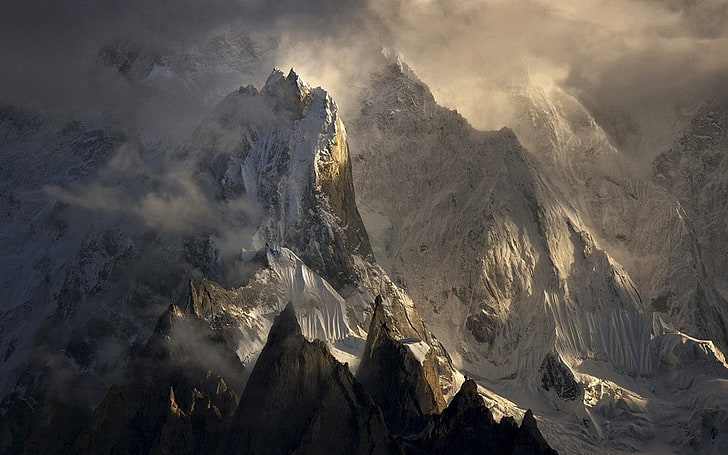
The Himalayas: An Overview
The Himalayas, which extend across five countries (Bhutan, India, Nepal, China, and Pakistan), are the highest and most famous mountain range in the world. It is consists mainly of uplifted sedimentary and metamorphic rock.
The Himalayas are known for their towering peaks, including Mount Everest, the highest point on Earth, which stands at 8,848 meters (29,029 feet) above sea level. This vast mountain range stretches over 2,400 kilometers (1,500 miles) and is home to numerous peaks exceeding 7,000 meters (23,000 feet) in height. In Pakistan, the westernmost part of the Himalayas includes the Nanga Parbat massif, with Nanga Parbat itself reaching a height of 8,126 meters (26,660 feet).
The Himalayas are characterized by their geological complexity. They were formed as a result of the collision between the Indian Plate and the Eurasian Plate, similar to the formation of the Karakoram Range. This collision, which began around 50 million years ago, continues to shape the region, leading to frequent earthquakes and ongoing uplift of the mountains.
The Himalayas play a vital role in the climate and hydrology of the region. They act as a barrier to the monsoon winds, causing heavy rainfall on their southern slopes while creating a rain shadow on the northern side. The range is also home to extensive glaciation, with numerous glaciers feeding into the major rivers of South Asia, including the Ganges, Brahmaputra, and Indus Rivers.
Ecologically, the Himalayas are incredibly diverse, supporting a wide range of habitats from tropical forests to alpine meadows. This diversity of ecosystems supports a rich variety of plant and animal species, many of which are endemic to the region. The Himalayas are also culturally significant, with numerous indigenous communities and ancient traditions closely tied to the mountains.
In conclusion, the youngest mountain range in Pakistan, the Himalayas, stands as a testament to the dynamic geological processes that continue to shape our planet. Its breathtaking landscapes, towering peaks, extensive glaciers, and rich biodiversity make it a significant natural wonder. Understanding and appreciating this mountain range not only enhances our knowledge of the Earth’s geological history but also underscores the importance of preserving these magnificent environments for future generations.
Source: To ensure the accuracy and authenticity of the information provided, the following sources were referenced:
- Pakistan | Himalayas, Karakoram, Indus – Britannica
- The Himalayas – World Atlas
- List of Mountain Ranges in Pakistan – Wikipedia
- Himalayas – Pakistan Embassy Tokyo