
Excerpt: This post answers the questions “Who was the first Chief Minister of KPK Pakistan? What is the name of first Chief Minister of Khyber Pakhtunkhwa? Who was the first CM of KPK Pakistan?”
Khyber Pakhtunkhwa (KPK), formerly known as the North-West Frontier Province (NWFP), holds a significant place in Pakistan’s history. Among its numerous political milestones, the appointment of its first Chief Minister stands out as a notable event, marking the beginning of organized governance in the province just after the formation of Pakistan in 1947. This individual played a crucial role in laying the foundations for the region’s development and political stability.
Who Was the First Chief Minister of KPK, Pakistan?
The honor of being the first Chief Minister (CM) of KPK goes to Khan Abdul Qayyum Khan. He was a prominent political figure and a close associate of Pakistan’s founding leader, Quaid-e-Azam Muhammad Ali Jinnah. His tenure was pivotal in establishing the initial administrative framework that supported the integration and development of the province within the newly formed nation.
When Pakistan was formed, Khan Abdul Jabbar Khan, popularly known as Dr. Khan Sahib, was the Chief Minister of the North-West Frontier Province (N.W.F.P.), which is now called Khyber Pakhtunkhwa. He was a member of the Indian National Congress and was appointed Chief Minister by George Cunningham, the Governor of KPK at that time. He served as the Chief Minister from March 16, 1945, to August 22, 1947.
He was succeeded by Abdul Qayyum Khan Kashmiri on August 23, 1947. Abdul Qayyum Khan belonged to the All India Muslim League and became the new Chief Minister of Khyber Pakhtunkhwa.
Khan Abdul Qayyum Khan: The First CM of KPK
Early Life and Political Journey
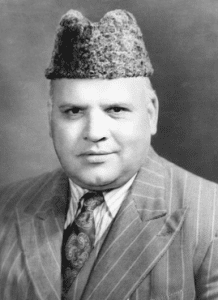
Khan Abdul Qayyum Khan was born on July 4, 1901, in Chitral, a region known for its rich cultural heritage. He acquired his education at Aligarh Muslim University and later pursued law. His political career began during the British Raj, where he joined the All India Muslim League, advocating for the rights of Muslims in India. Khan was an ardent supporter of the Pakistan Movement and played a key role in mobilizing support for the creation of Pakistan.
Tenure as Chief Minister
Elected as the first Chief Minister of KPK on August 23, 1947, Khan Abdul Qayyum Khan faced the monumental task of integrating this diverse province into the nascent state of Pakistan. During his tenure, he focused on establishing a robust administrative framework, enhancing law and order, and promoting socio-economic development. His policies aimed to bridge the gap between the tribal areas and settled districts, fostering unity and cohesion among the people.
Achievements and Challenges
One of Khan’s significant achievements was the establishment of Khyber Pakhtunkhwa University (now University of Peshawar), a major educational institution aimed at cultivating future leaders. He also implemented various land reforms and worked towards improving infrastructure, including healthcare and transportation.
However, Khan’s tenure was not without challenges. Managing the region’s tribal diversity and addressing the concerns of different ethnic groups required careful navigation. He faced political opposition and occasional unrest but remained determined to achieve his vision of a united and progressive province.
Legacy
Khan Abdul Qayyum Khan’s legacy as the first Chief Minister of KPK is marked by his dedication to the region’s development and his efforts to integrate the tribal and settled areas into a cohesive unit. His contributions laid the groundwork for subsequent leaders, ensuring that KPK remained an integral part of Pakistan’s socio-political landscape.
Khyber Pakhtunkhwa Assembly: An Overview
Introduction to Khyber Pakhtunkhwa Assembly
The Khyber Pakhtunkhwa Assembly, established after Pakistan’s independence, serves as the unicameral legislative body of the province. It plays a vital role in legislation, governance, and development, reflecting the diverse cultural landscape of the region.

Functions and Structure of the Assembly
The Khyber Pakhtunkhwa Assembly operates under a unicameral system, where members are elected by the people of KPK. The Assembly is responsible for passing laws, approving budgets, and overseeing the executive branch of the provincial government.
Key Legislative Initiatives
Over the years, the Khyber Pakhtunkhwa Assembly has undertaken numerous legislative initiatives aimed at enhancing socio-economic development. These efforts include educational reforms, healthcare improvements, infrastructure projects, and initiatives aimed at promoting peace and stability in the region. The Assembly has also played a pivotal role in ensuring that the province’s rich cultural heritage is preserved and celebrated.
Challenges and Achievements
The Khyber Pakhtunkhwa Assembly faces several challenges, including political instability, economic disparities, and security concerns. Despite these hurdles, the Assembly has achieved significant milestones in fostering regional development and addressing the needs of its diverse population. Its continuous efforts strive to achieve sustainable growth and improve the quality of life for the people of KPK.
The leadership of Khan Abdul Qayyum Khan as the first Chief Minister of KPK and the establishment of the Khyber Pakhtunkhwa Assembly represent pivotal moments in Pakistan’s history. Khan’s tenure set the stage for future development, while the Assembly continues to play a crucial role in governing and progressing the province. Both symbolize the determination and resilience of Pakistan’s leaders and institutions, working towards a unified and prosperous nation.
Sources: The above answer is based on information from
- “Khan Abdul Qayyum Khan: A Political Biography” by Syed Wiqar Ali Shah
- Official website of the Khyber Pakhtunkhwa Government
- Official Website of Chief Minister of Khyber Pakhtunkhwa
- “Khan Abdul Qayyum Khan: A Political Biography” by Syed Wiqar Ali Shah
- Official website of the Khyber Pakhtunkhwa Government